
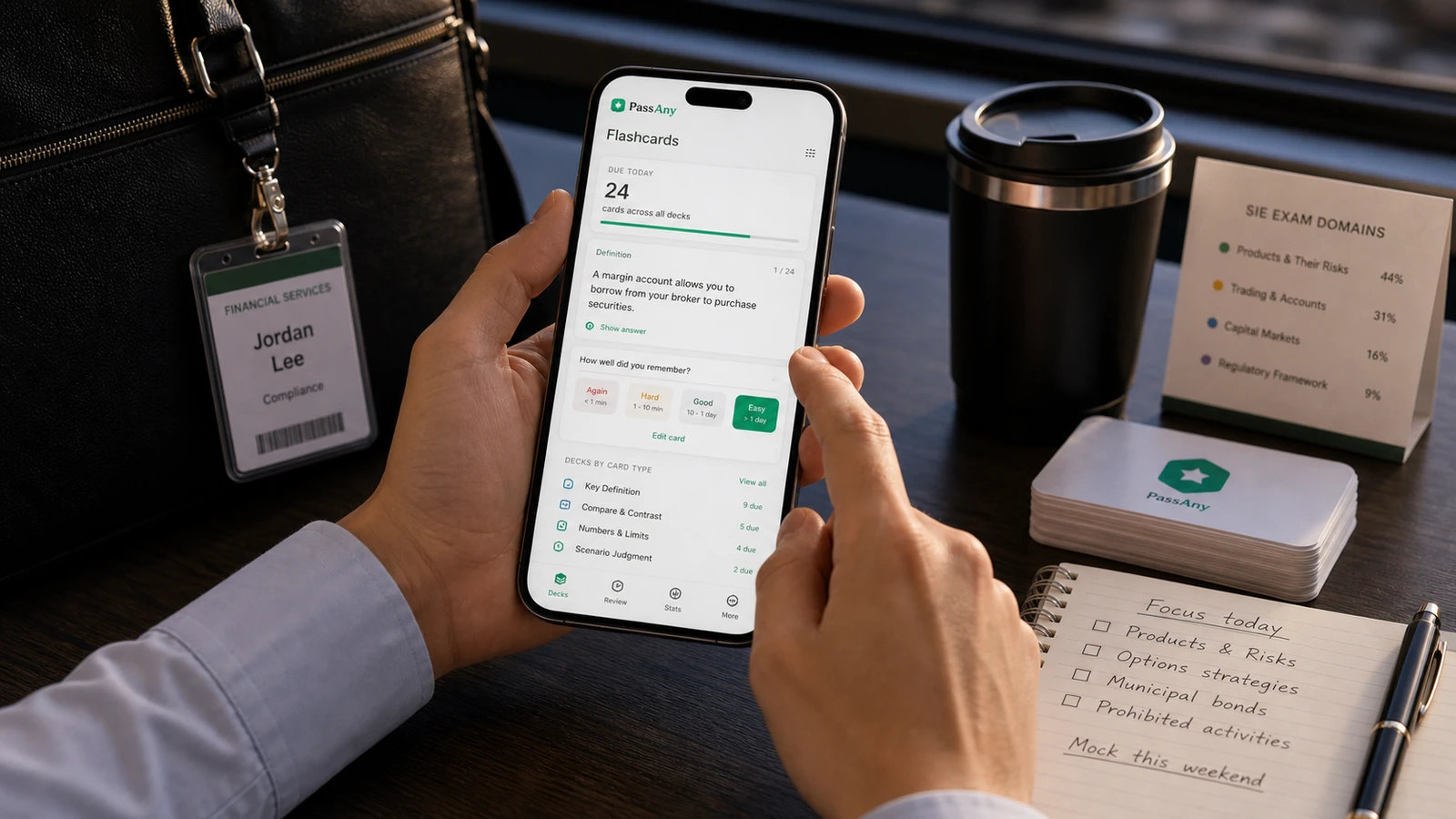




SIE flashcards that flip to a full explanation.

Not a word list. Each card is a real SIE-style question that flips to the reasoning behind it — and spaced repetition brings it back right before you'd forget it.

8 card typesIllustrated front & backSpaced repetitionFlip to explanation
A PrepScore SIE flashcard flipping from a question to its full explanation
What it solves

Some points are lost because the fact almost came back.

Flashcards aren't a replacement for practice — they're the memory layer that keeps small rules ready the moment a question needs them.

Definitions

You need clean recall for the terms the exam asks point-blank.

Definitions and product features become quick review cards instead of long re-reading sessions.

Numbers

Limits, deadlines and formulas disappear unless they come back.

Spaced review returns the rule before memory fades, and keeps hard cards coming back sooner.

Look-alikes

Similar products and rules need contrast, not repetition alone.

Compare-and-contrast cards put two confusable ideas side by side so they finally separate.

Eight card types

Eight decks, each trains a different exam skill.

Cards span the four FINRA domains, sorted by the kind of thinking the SIE tests — not just "definitions." Each deck has its own cover and its own due queue.

Front, then flip

Every card flips to the full reasoning — not just the answer.

The front is a real SIE-style question with four self-test options. Flip it and the back doesn't just say "C" — it explains the whole card:

  • The answer — and what your pick told you
  • Core idea — the concept the card is really about
  • Exam focus — exactly how the SIE tests it
  • Memory hook — a sticky way to keep it
  • Quick self-check — a recall question to prove it stuck
  • Source — the FINRA outline or SEC rule it comes from
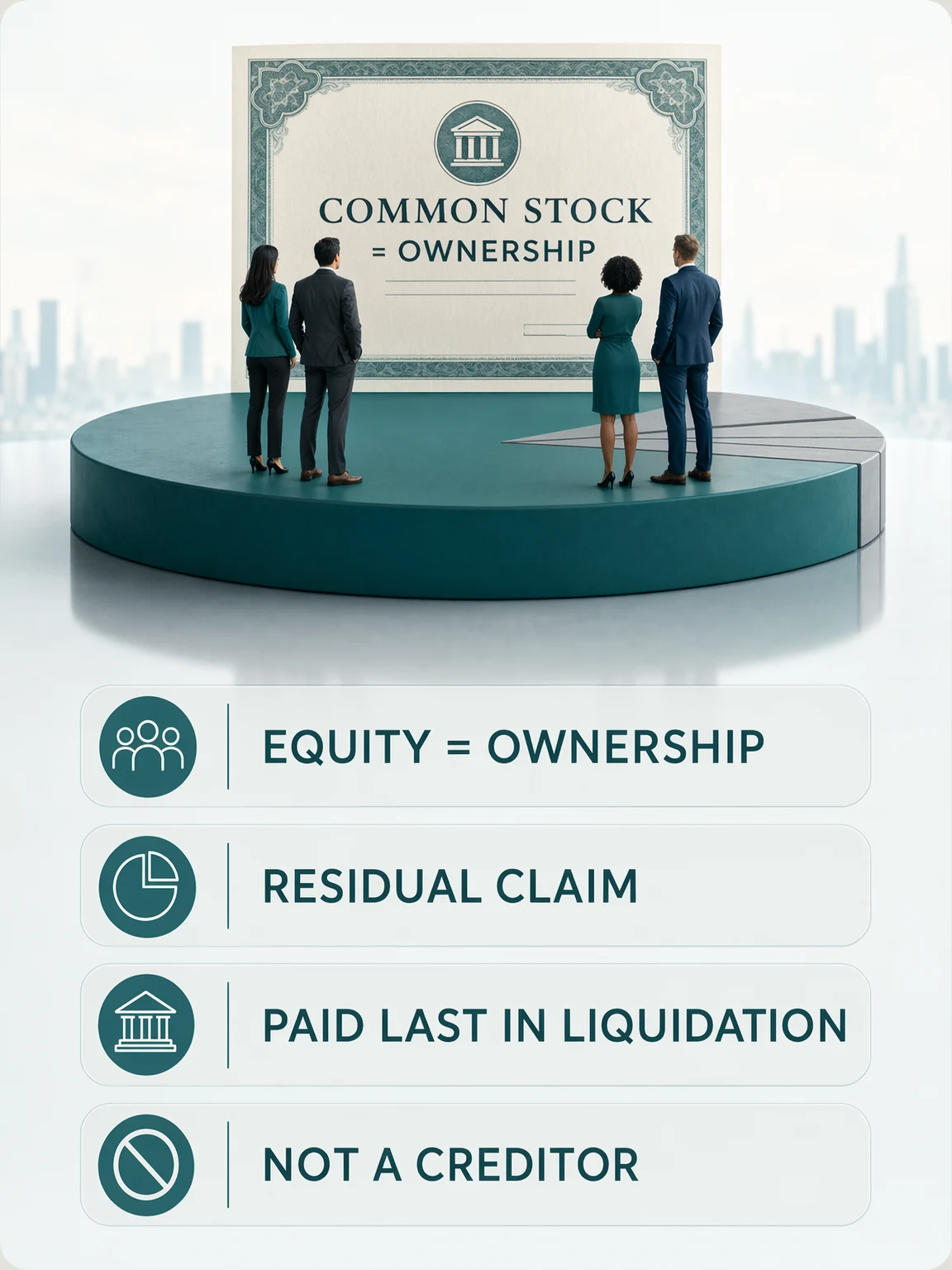
SIE flashcard front: a question about what owning common stock makes you
Front · the question
SIE flashcard back: full explanation of common stock as equity ownership with a memory hook and source
Back · the explanation
Spaced repetition

You rate each card. It schedules the next review.

A "Due today" count keeps every session small. After you flip, you rate how it felt — and the card comes back on the right day, with the hard ones returning sooner.

Againback in 1 day
Hardback in 2 days
Goodback in 4 days
Easyback in 10 days

Overdue cards come back first, and the queue is reshuffled each session so you learn the fact, not the order.

Card art you can actually keep

Each card is illustrated front and back, so a rule isn't a wall of text — it's an image your memory can grab. Tap any card to open it full-size and download it for offline review.

  • Illustrated front (question) and back (explanation)
  • Tap to enlarge and download the card
  • Built from the same SIE content as your practice questions

Strongest paired with practice

When a practice or mock question exposes a fuzzy rule, the matching deck keeps it warm until exam day. Memory plus application beats either one alone.

FAQ

SIE flashcard questions

What makes PrepScore's SIE flashcards different?
Each card is a real SIE-style question that flips to a full explanation — core idea, exam focus, a memory hook, a self-check and the FINRA source — across 8 card types, not a one-line definition list.
How does the spaced repetition work?
You rate each card after you flip it — Again (1 day), Hard (2 days), Good (4 days) or Easy (10 days) — and it returns on that schedule. A "Due today" count keeps each session short, and hard cards come back sooner.
What are the 8 SIE flashcard types?
Key Definition, Compare & Contrast, Numbers & Limits, Scenario Judgment, Step-by-Step, Rule & Exception, Trap Spotting and Memory Hook — each trains a different way the SIE tests you.
Should I only use flashcards for the SIE?
No. Flashcards hold the facts; practice questions and mock exams prove you can apply them under exam conditions. Use them together.
From the deck

Two real flashcards

Each card takes apart every option, not just the credited one — that is where the look-alike terms get separated.

Compare & Contrast · FDIC insures bank deposit accounts; it does NOT cover securities held at a broker-dealer (

A customer keeps a savings account at a national bank and a brokerage account holding stocks and bonds at an affiliated broker-dealer. Which federal entity provides insurance protection on the customer's bank savings deposit?

  1. AThe Federal Deposit Insurance Corporation (FDIC)correct
  2. BThe Securities Investor Protection Corporation (SIPC)
  3. CThe Federal Reserve Board (FRB)
  4. DThe Office of the Comptroller of the Currency (OCC)
Why each option is right or wrong

A. The FDIC is the federal insurer for deposit accounts (checking, savings, money market deposit accounts, and CDs) held at FDIC-member banks, currently up to $250,000 per depositor, per insured bank, per ownership category. The customer's bank savings account is a deposit, so it falls under FDIC coverage.

B. SIPC protects customer cash and securities held at a failed SIPC-member broker-dealer (up to $500,000, including a $250,000 limit for cash), but it does NOT insure bank deposit accounts. SIPC would apply to the stocks and bonds at the broker-dealer, not to the bank savings account. This bank-vs-BD split is exactly what the question tests.

C. The Federal Reserve Board conducts monetary policy and supervises member banks and bank holding companies, but it is not a deposit insurer. Insuring bank deposits is the role of the FDIC, a separate agency.

D. The OCC charters, regulates, and supervises national banks and federal savings associations. It is a supervisory/chartering authority, not an insurance fund. Deposit insurance for those same banks is provided by the FDIC.

Key Definition · Easy (loose) money policy — actions, intent (stimulate), rate effect.

A customer asks about Easy (loose) money policy. Which statement is TRUE?

  1. AOpen market operations are the Fed’s primary tool and involve buying or selling government securities to affect bank reserves.
  2. BWhen the Fed buys securities, it adds reserves to the banking system and eases the money supply.
  3. CWhen the Fed sells securities, it drains reserves from the banking system and tightens the money supply.
  4. DEasy money policy seeks to stimulate the economy by increasing the money supply or lowering rates.correct
Why each option is right or wrong

A. The distractor is a real rule, but for Open market operations as the primary/most-used monetary tool: Open market operations as the primary/most-used monetary tool. This question instead turns on Easy (loose) money policy — actions, intent (stimulate), rate effect.

B. Use that statement for OMO direction: OMO direction — Fed BUYS securities = adds reserves = eases money supply. It differs from this card because Easy (loose) money policy requires Easy (loose) money policy — actions, intent (stimulate), rate effect.

C. It shifts categories to OMO direction: OMO direction — Fed SELLS securities = drains reserves = tightens money supply. The answer here depends on Easy (loose) money policy — actions, intent (stimulate), rate effect.

D. Easy (loose) money policy is resolved by this fact: Easy (loose) money policy — actions, intent (stimulate), rate effect. The distractors borrow from Open market operations as the primary/most-used monetary tool and OMO direction or alter that boundary.

Keep every rule warm until exam day.

Start with free SIE practice, then let the decks bring back what you're about to forget.